
Embedded Systems
Internship with STM32
& ARM Cortex-M4
Build practical embedded systems skills using STM32, Embedded C, microcontroller peripherals and communication protocols through a structured 4-week internship.
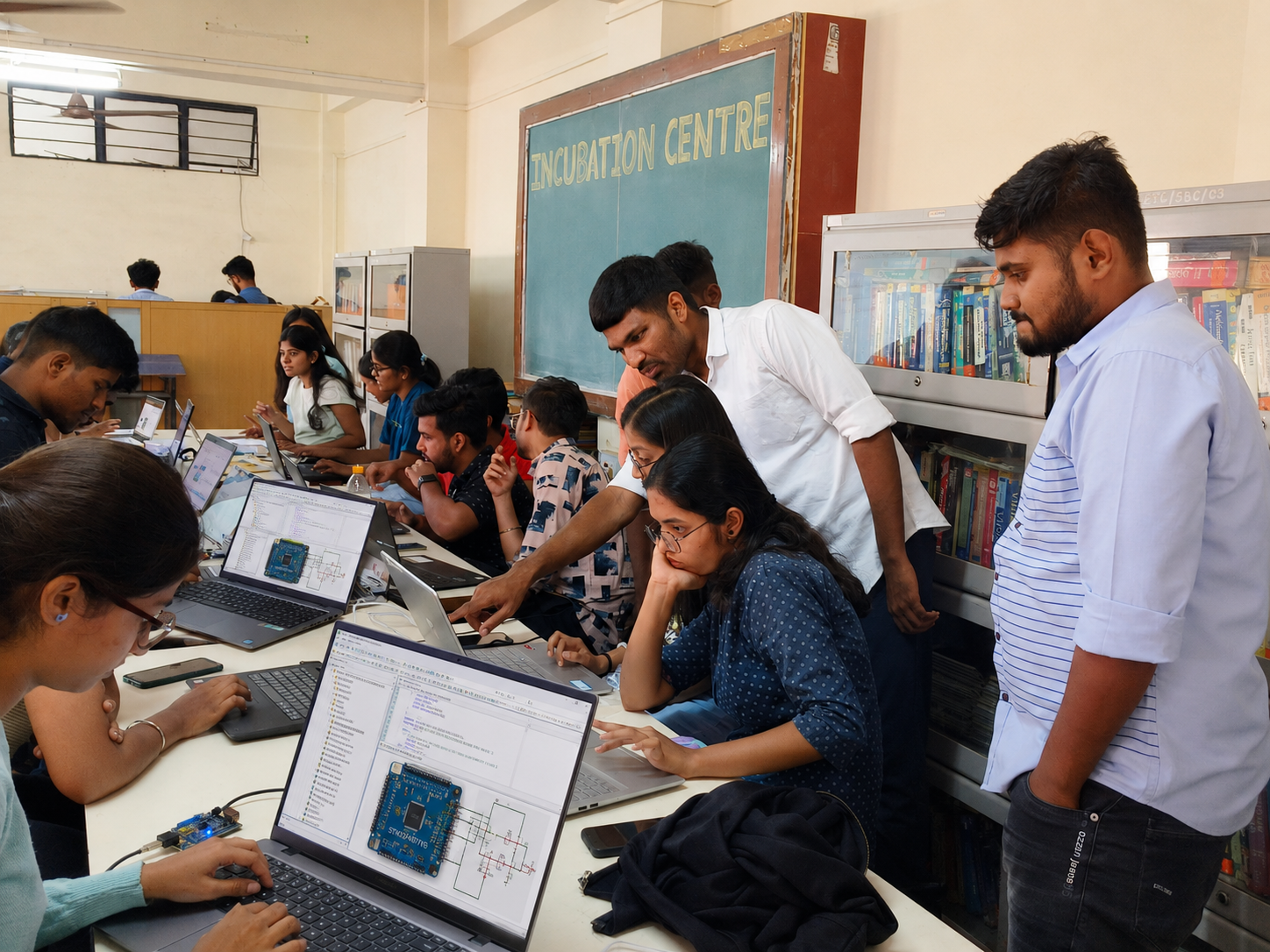
Learn by building. Practical embedded systems training with STM32, Embedded C and project-based learning.
Students from leading engineering institutions
learn with Make IoT
Students and learners from universities and autonomous engineering colleges have participated in Make IoT's technical workshops and programs.
Build the skills.
Show the work.
A structured four-week internship combining guided learning, practical exercises and project work — giving you technical experience and tangible work you can confidently showcase.
Hours of structured content
Embedded coding exercises
Capstone projects
Structured internship
Turn your work into something you can showcase.
Build evidence of what you learned — not just a line on a certificate.
Add the internship experience to your resume.
Showcase completed projects in your portfolio.
Share your projects and learning journey on LinkedIn.
Discuss your project work during technical interviews.
From embedded fundamentals.
Build what works.
A structured 4-week internship covering Embedded C, STM32 microcontroller programming, peripherals, communication protocols, simulation and practical project work.
Structured learning • Practical exercises • Project-based application
No development board.
No excuse to fall behind.
The internship is designed so you can begin learning and practising from your laptop without needing dedicated STM32 hardware.
STM32CubeIDE
Use STM32CubeIDE for project development, code compilation, debugging and working with STM32 firmware projects.
QEMU Emulation
Practise and debug supported STM32 firmware concepts in a software-based environment without physical hardware.
Proteus Simulation
Visualise and test selected microcontroller circuits, peripherals and interfacing concepts through simulation.
Register-Level + HAL
Learn what happens underneath the abstraction by working with both direct register configuration and STM32 HAL APIs.
// GPIO toggle — register level vs HAL
// Register-level: direct write to ODR

GPIOA->ODR ^= (1U << 5);  // toggle PA5

// HAL equivalent
HAL_GPIO_TogglePin(GPIOA, GPIO_PIN_5);

// UART interrupt-driven receive (HAL)
HAL_UART_Receive_IT(&huart2, (uint8_t*)&rxByte, 1 );
Register Level
Understand how the peripheral is controlled directly through microcontroller registers.
STM32 HAL
Implement the same functionality using STM32's Hardware Abstraction Layer.
Get the documents.
Keep the proof.
Complete your internship with formal documentation that you can submit to your college, add to your resume and showcase as part of your professional profile.
Internship Document
Internship Offer Letter
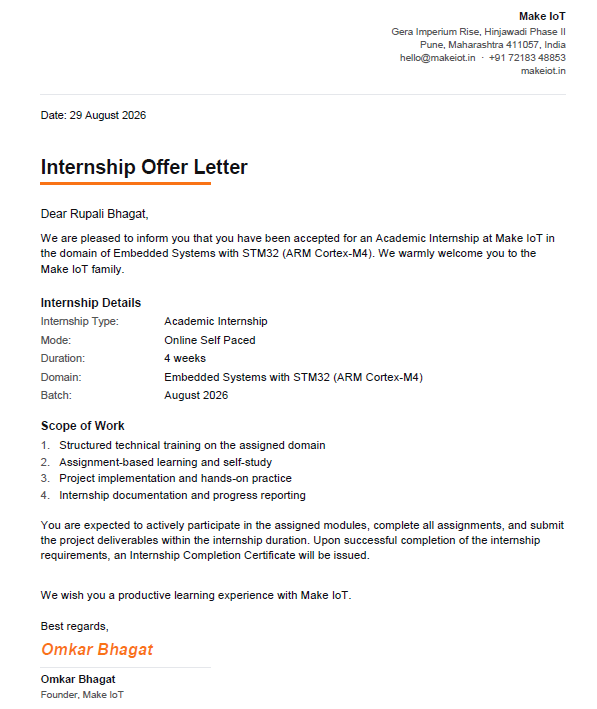
Issued as part of your enrollment
Receive your internship offer letter as part of your program documentation after successful enrollment.
Internship Document
Completion Certificate
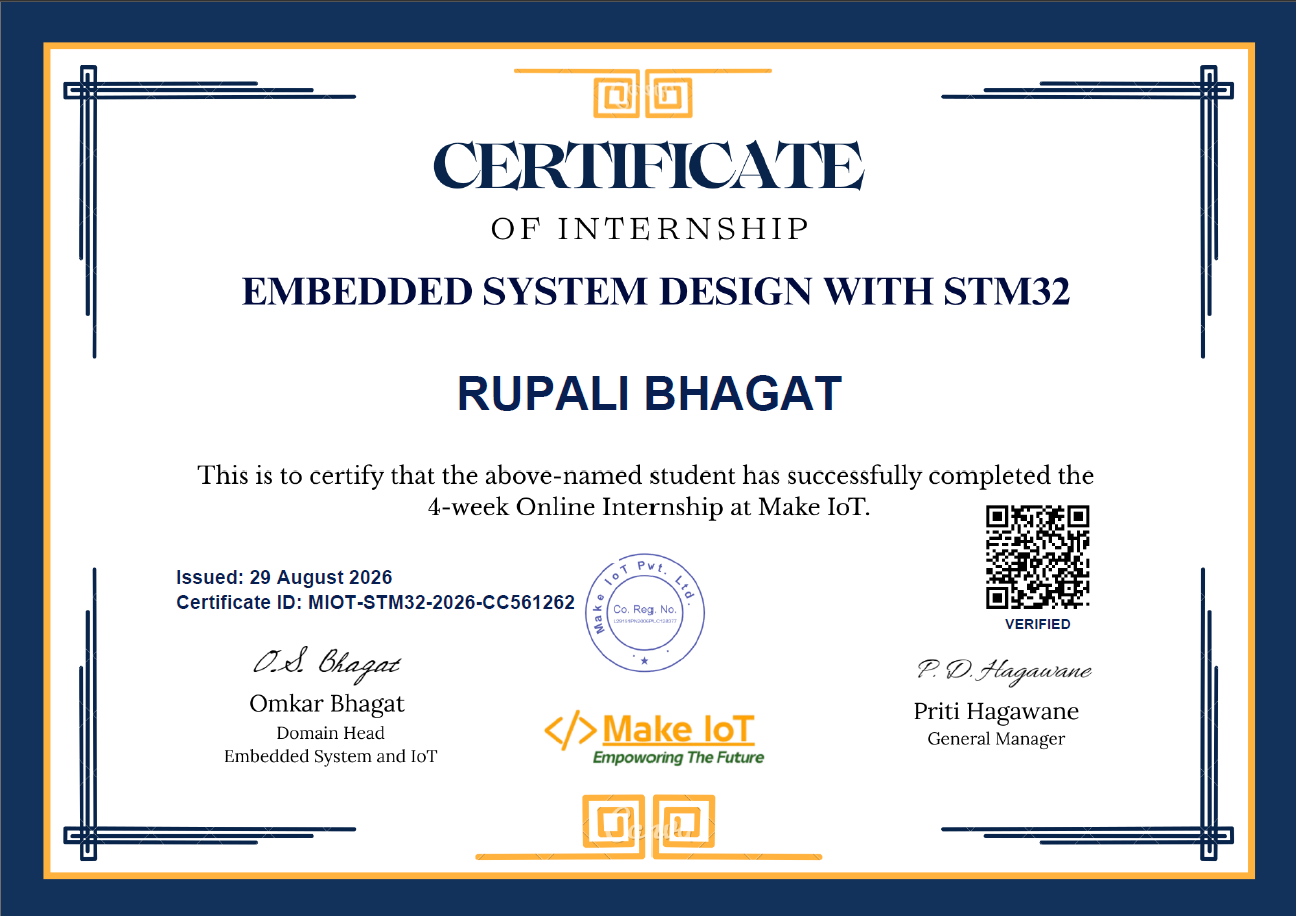
Earned after completing the internship
Complete the required internship activities and assessment to receive your completion certificate.
College
Submit your internship documentation
Use your offer letter and completion certificate as part of your college internship documentation.
Resume
Add your internship experience
Include the internship, technical skills and projects in your resume and portfolio.
Showcase your achievement
Add the internship and certificate to your LinkedIn profile to document your technical learning journey.
Get certified
in 6 steps.
A simple path from enrollment to certification, combining structured learning, practical work and assessment.
Register
Submit your details and choose the internship program.
Enroll & Pay
Complete your enrollment and secure your internship slot.
Get Offer Letter
Receive your internship offer letter as part of your enrollment documentation.
Learn & Build
Follow the 4-week learning path, complete exercises and work on practical projects.
Submit Assessment
Complete the required assessment and submit your project work for evaluation.
Get Certified
Successfully complete the evaluation and receive your internship completion certificate.
One payment.
Everything included.
Get ₹200, your friend gets ₹200
Share your referral code with a friend. When your friend enrolls and completes the payment using your referral code, both of you receive ₹200 as per the referral program.
Learn from real-world
embedded systems experience.

Omkar Bhagat
Founder, Make IoT
An embedded systems engineer and educator with 5+ years of industry experience across automotive embedded systems and consumer electronics.
Omkar has worked across low-level embedded development, AUTOSAR, Edge AI and IoT, with experience at organizations including KPIT and Schaeffler. He currently works with FRANKE while building Make IoT to help engineering students develop practical technical skills.
He has trained 10,000+ students through technical workshops and learning programs and also mentors innovators at AIC-ADT Baramati.
Education
Bachelor's in Electronics & Telecommunication Engineering
Master's in Digital Systems
Everything you need to know
before you enroll.
Find answers about the STM32 internship, curriculum, practical work, tools, certificate, offer letter, eligibility and enrollment process.
What is the Embedded Systems with STM32 internship?+
This is a structured 4-week online internship focused on practical embedded systems development using STM32 and ARM Cortex-M. The program covers embedded fundamentals, Embedded C, STM32 peripherals, register-level programming, STM32 HAL, communication protocols, simulation, debugging, exercises and practical projects.
Who is this STM32 internship for?+
The internship is designed primarily for engineering students and learners who want to build practical skills in embedded systems, microcontrollers and firmware development. It is suitable for students from Electronics, Electrical, Electronics & Telecommunication, Instrumentation, Computer Engineering and related engineering disciplines.
Do I need prior STM32 experience?+
No. The program follows a structured learning path from fundamentals to practical implementation. Basic programming knowledge is helpful, but the internship progressively introduces ARM Cortex-M, STM32 architecture, Embedded C, peripherals and firmware development.
Do I need an STM32 development board?+
No dedicated STM32 hardware is required to complete the internship. The practical workflow uses software-based tools including STM32CubeIDE, QEMU and Proteus simulation, allowing you to practice and debug concepts without requiring a physical development board.
What will I learn during the STM32 internship?+
The curriculum covers ARM architecture and Cortex-M fundamentals, STM32 architecture, Embedded C, GPIO, timers, ADC, PWM, UART, I²C, CAN, register-level programming, STM32 HAL programming, STM32CubeIDE, simulation, debugging and practical embedded systems development.
What is the difference between register-level programming and HAL programming?+
You will learn both approaches. Register-level programming helps you understand how microcontroller peripherals work by directly configuring registers, while STM32 HAL provides a higher-level abstraction for developing applications more efficiently. Learning both helps you understand what the abstraction layer is doing.
What tools are used in the internship?+
The internship uses a software-based embedded development workflow including STM32CubeIDE, QEMU and Proteus simulation. These tools allow you to write, build, simulate and debug embedded firmware without depending entirely on physical hardware.
How much practical work is included?+
The internship includes 20+ practical exercises and three capstone projects designed to help you apply the concepts covered in the curriculum.
Is the internship completely online?+
Yes. The internship is conducted online with recorded learning content and live doubt-clearing sessions. You can follow the structured 4-week learning path while using the live sessions to clarify technical questions.
How long is the internship?+
The internship duration is 4 weeks. The program follows a structured learning path covering fundamentals, programming, peripherals, communication protocols, practical exercises and project work.
Will I receive an internship offer letter?+
Yes. An internship offer letter is provided as part of the enrollment documentation and documents your participation in the internship program.
Will I receive an internship completion certificate?+
Yes. After successfully completing the required learning activities, exercises, project work and assessment or evaluation, you receive an internship completion certificate with a verification mechanism.
Can I submit the internship certificate to my college?+
The internship documentation is designed to support students who need to document their internship participation and completion. Final acceptance is determined by your college or university's internship requirements and policies, so students should confirm any specific documentation requirements with their institution.
Can I add this internship to my resume and LinkedIn profile?+
Yes. After completing the internship, you can include the internship experience, skills developed and projects completed in your resume and LinkedIn profile. You should accurately represent the work you completed during the program.
What do I receive after completing the internship?+
Your internship journey includes structured 4-week learning content, 20+ practical exercises, three capstone projects, live doubt-clearing support, an internship offer letter, an internship completion certificate and practical embedded systems project experience.
When can I start the internship?+
You can begin accessing the structured internship content after completing your enrollment, allowing you to start the learning journey without unnecessary waiting.
Is this an internship or a course?+
It is structured as an internship program combining technical learning, practical exercises, project work and evaluation. The program is designed to provide students with documented internship participation alongside practical embedded systems learning.
How do I enroll in the STM32 internship?+
Click the Enroll Now button, complete your enrollment details and proceed with the payment. After enrollment, you can begin the internship journey and access the program documentation and learning content according to the program process.
Is there a referral benefit?+
Yes. Make IoT provides a referral program where an eligible referral can provide a benefit to both the existing participant and the referred student after the referred student's enrollment is successfully confirmed.
What if I have a technical question during the internship?+
You can use the available live doubt-clearing sessions to ask questions and clarify concepts related to the internship curriculum and practical work.